
Finding Her Rhythm!
When most people lost hope, the Kumars didn’t. The family turned to music in their quest to help their daughter find harmony in life.
In early 2002, Jyotsna & Amit had to make a choice. Either remove their frail infant off the life support machine or proceed with a crucial surgery and face the consequences, including the possibility of their child never walking or talking.
What do you do when you have to fight against the odds? You do what Jyotsna & Amit did. You take it head-on. They took the courageous decision to give their daughter another chance. The result: their daughter, Anandita, survived the surgery.
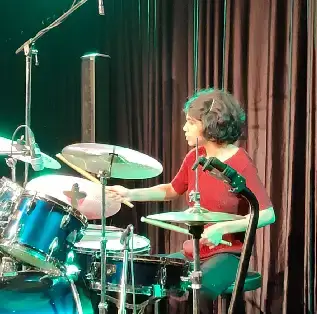
Fast forward to 2025, Anandita is a drummer, a certified Clinical Musician, a Djembe teacher (Djembe is a goblet-shaped drum played with bare hands), and has several concerts to her credit. She may not be the only youngster to have such accomplishments; but she surely is one of the lucky few with Cerebral palsy (CP) to do so.
The promising present, however, is a result of having overcome many challenges in the past. The real journey for Anandita and her family began after her surgery. What followed were several types of therapies. The family did its best to help Anandita cross one hurdle at a time, encouraging her to “explore without being outcome-oriented”. This approach gave Anandita the freedom to try out different avenues without feeling the pressure to fit in.
One such exploration led the family and Anandita to the music therapy program offered by the Pune-based WCCL Foundation. Her initial anxiety of playing drums waned in the face of a patient and compassionate teacher, an encouraging and supportive family, and her own perseverance. One beat at a time, Anandita slowly began to find a rhythm in which her hands, eyes, and feet began to sync with each other like never before.
Her training in drumming with the WCCL Foundation and subsequent enrolment at the Foundation’s Certificate Course in Clinical Musicianship (CCM) program, Jyotsna feels, was “the best decision because drumming helped Anandita find an outlet to express herself. Her body and mind began to sync.”
How does a musical instrument help people who have CP? Remarkably, it can, and in more ways than one. Usually, motor skills are severely impaired in people affected by cerebral palsy. Music helps cue motor skills as every beat necessitates hand and foot coordination to create the desired rhythm. Before joining the drumming sessions, Anandita struggled with eye, hand, and leg coordination. With drumming, her eye-hand-leg coordination improved tremendously as it facilitated motor movement and more importantly its timing.
Depending on the severity of their condition, many people with CP also find themselves favoring one side of their body. Anandita experienced the same. The reliance on the preferred side can, very often, lead to the weaker side becoming weaker if it is not attended to. While physiotherapy helps address this to a great extent, interestingly, playing a musical instrument too can help. For Anandita, drumming not only strengthened her dominant side but also improved her weaker side.
Cognitively, such individuals struggle with attention, learning, emotions, conversing, and interacting with others. They have difficulty processing information or instructions. A musical instrument can offset some of these challenges. In drumming, for instance, the different elements of playing the drums compelled Anandita to become more attentive.
Beyond developing Anandita’s motor and cognitive skills, drumming gave this youngster an identity of her own. Little did she know that a casual exploration of drumming would lead her to find her Ikigai (that which gives value and joy to life). In a beautiful and inspiring way, drumming gave her a unique opportunity to engage with the world.
For someone whose expression was limited, Anandita has come a long way. Many people with CP shy away from social interactions and holding conversations. Until a few years ago, Anandita was in the same boat. Donning the hat of a performer and teacher, however, enabled Anandita to initiate and hold conversations. Interacting with other persons with disabilities also amplified her empathy for them. “As a teacher, I realize very often that I have to customize lessons for students based on their interests and abilities,” says Anandita. Having reaped the benefits of music therapy, Anandita is keen to help others like her.

Through Club Youngistan, a virtual space to teach and equip persons with disabilities with skills they are interested, Anandita teaches Djembe to around 10 children. In addition to that she is takes clinical musicianship sessions in Prasanna Autism Centre, Pune on a weekly basis. To top it off, she has been hired by her school Vidya Jyoti, Pune as a Drum Teacher, and now, she teaches in the same class where she studied as a student.
As a performer on stage, she is on a par with co-performers. As a teacher, she has great consideration for her students and her heart beats with joy when they perform in a concert. While society may consider her as a person with a disability, Anandita has found her identity as an ‘ability specialist’. The ability to rise against all odds, to discover her passion, and to march to the beat of her own drum!
- Written by Ms. Nandhini Shanmugham for WCCL Foundation.